INTRODUCTION
As we promised on X, we wanted to share our experience working with the Defense Logistics Agency, and why more small businesses or startups should take this route as well.
But first a full disclaimer: We are not a manufacturer (yet), but a distributor of products. Our niche is in the air and oil filters, but we have fulfilled contracts in a good range of FSCs (Federal Supply Class).
So we can’t talk about the manufacturing route but the distributor route for it.
In the final part of the post, we will dedicate a section entirely to the manufacturing route, and how startups could approach this route, but again, it’s to you to test it.
FIRST THINGS FIRST: WHAT IS THE DEFENSE LOGISTICS AGENCY
The Defense Logistics Agency (DLA) provides logistical, acquisition, and technical support for the Army, Navy, Air Force, Marine Corps and other federal agencies and allies.
Basically the DLA manages the supply chain for several Department of Defense entities inside and outside the US territory. From bolts to helmets to uniforms, the DLA manages all that in several posts around the United States and the world.
But you should be wondering why we as small businesses or startups must work with the DLA.
The answer is very simple: during the COVID pandemic, the DLA lost a huge percentage of the manufacturing base in the US, especially small shops focused in particular or critical components for the military aerospace industry.
Many manufacturing shops lost a key member of the team or they lost the founder of it; which in many cases was the person with the big amount of knowledge of the products being built on that shop.
So, now we have the chance to revive that, we can build critical components with better tech and resources, we just have to know how we can do that, and in this article, we will try to share the things we have learned about working with the Defense Logistics Agency for almost a year now.
For full transparency: Our CAGE is 09D43.
HOW TO START WORKING WITH THE DLA
Assuming you already have a working business, and you have a proper physical location for it (not a P.O or a virtual office), let’s discuss the steps you will need to start working with the DLA
GET A CAGE CODE
Your company will need a CAGE code. CAGE stands for Commercial and Government Entity code, which is basically a five-character unique identifier for a company, organization or government agency that supplies goods or services. In order to get this code, you will need all the company’s paperwork including: articles of incorporation, EIN letter from the IRS, company registration with the state, phone number, email address, principal NAICS code for it (a key piece of information if you are a manufacturing company), physical address where you conduct business with an official document that probes that (leasing agreement or title of the property attached to your company)
With all this information, you will need to visit SAM.gov entity registration portal and start the process there.
You can follow all the steps to do that described in this very helpful video
This process takes a few days if you follow the steps, and it’s very easy to do: you just need patience and a little attention to detail but you can do it.
We got our CAGE 12 days after we summited all the information
NOW IT’S TIME TO REGISTER WITH THE DLA
Once you got your CAGE code, you will visit DLA DIBBS, which stands for DLA Internet Bid Board System and you will start the process for the registration on this link https://www.dibbs.bsm.dla.mil/Register/
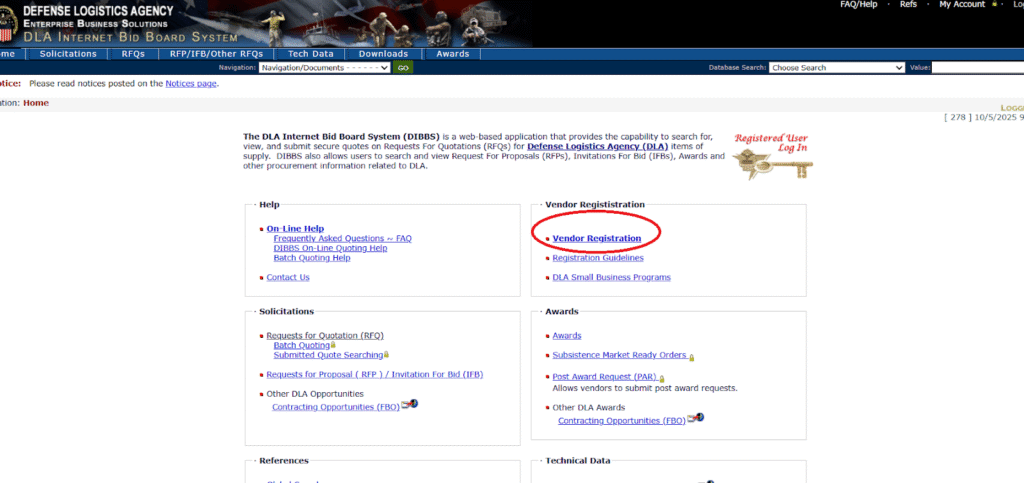
The first thing you will see is that they request your CAGE code. You add it there, and you start the process.
In the final part of the registration process, they will send a physical letter to your location with an 11 digital number on it.
This PIN will ensure that you own or lease that location you added in the registration process.
This process can take up to 20 or 30 days, so be patient.
We got our physical address verification letter in 25 days after you submitted the registration with the DLA.
Once you get that letter, you take the PIN and you put it in the DLA’s DIBBs website in order to complete the registration, and voila. You are in.
LET’S BUILD SOME VENDOR RELATIONSHIPS FIRST
If you take the distributor path, before doing any bidding on DIBBS; you need to build some vendor relationships first.
The best tip we can share here? Look at your backyard first.
What we mean by that is by looking at vendors or manufacturers in a radius of 100 to 250 miles or less. This will allow you to shake hands and go directly with them to negotiate a better deal on price or delivery times for your purchases, even if you have history, you can build a NET30 account with them, and of course: nothing beats negotiating face to face.
That’s the approach we took: we have formed relationships with Caterpillar (through a local dealer that is less than 10 miles of our office), Donaldson, Daimler, JCB, and McMaster-Carr (the goat for us in this space).
NOW IT’S TIME FOR BIDDING
Once you have formed those relationships with vendors, now it’s time for bidding inside DIBBS.
You can search for open solicitations inside DIBBS by two ways: RFQs or Request for Quotation, or RFP or Request for Proposal
The RFQs are located on this link https://www.dibbs.bsm.dla.mil/RFQ/
and the three most commons to do it are:
-
- Search NSN or National Stock Number
-
- Search by Federal Supply Class: this is basically the category of products where the products is part of
-
- Search by CAGE code: you can search using the CAGE code for the approved source for that particular product
Let’s see it with an example: let’s say I want to search for all open solicitations linked to McMaster-Carr products.
So, basically I take one of the McMaster-Carr CAGES codes (in this case 39428), and I put select Approved CAGE in the Search Categories dropdown menu, and click search
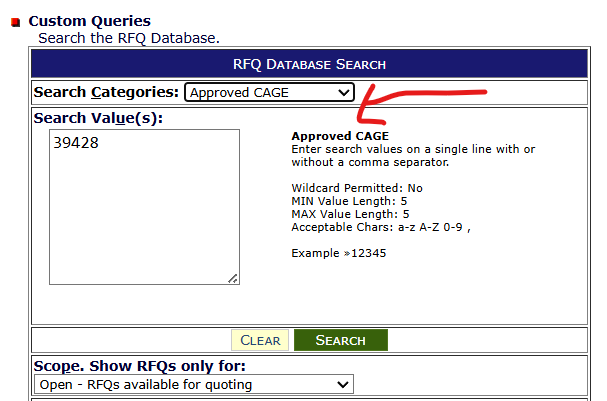
And this will find all open solicitations available today at DIBBS (October 5th, 2025) (See the image below)
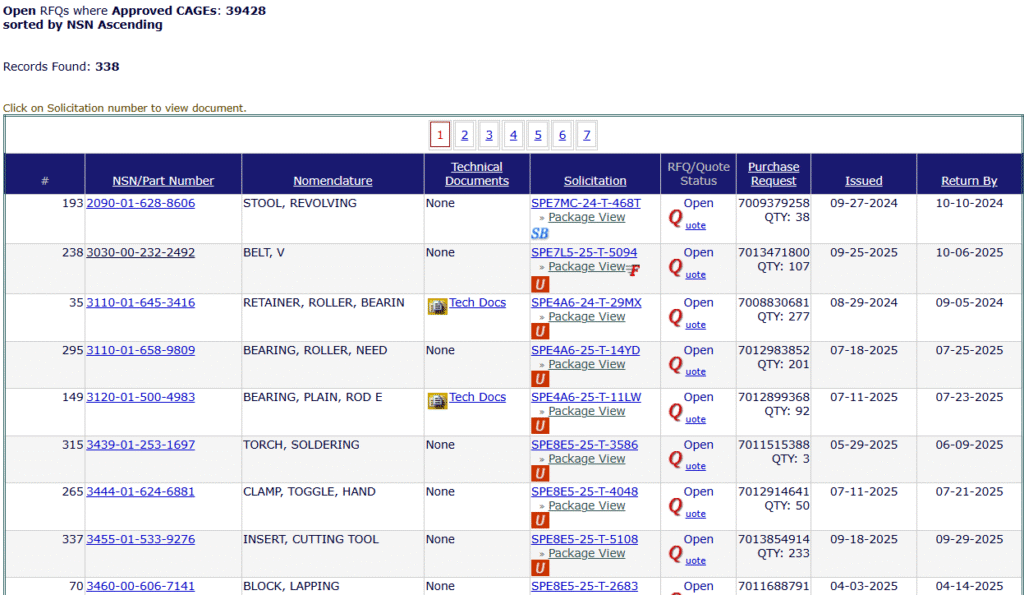
Now, let’s take a deep look at a detailed view of one of those, let’s pick the one for the NSN
When you visit that link, you will see something like this
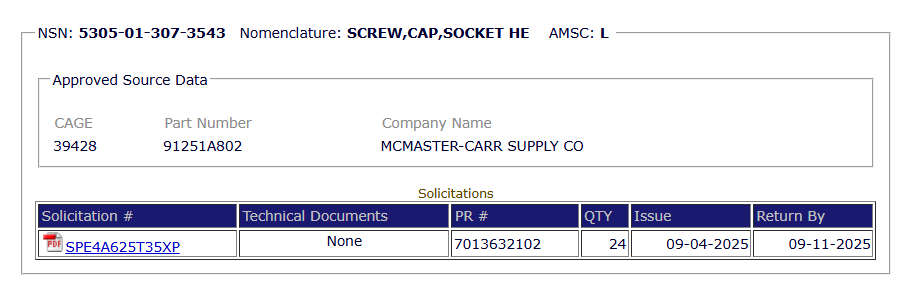
What information can you extract from this page right here? A lot
First the approved source for this product is only McMaster-Carr. What this means? It says that in order to win the award for it: first you need to prove that you will buy this directly from McMaster-Carr and nobody else.
This is what the DLA calls traceability, which means that the product is coming directly from the manufacturer itself or if you buy it from a distributor, that company must be approved by the OEM to sell that product.
In the case of McMaster-Carr is very easy: you just send an email to sales@mcmastercarr.com requesting a quote for this order:
P/N 91251A802
Qty 24
and in the P.O you mention in the email that the Solicitation Number is included there. In this case: SPE4A625T35XP
Another piece of information you can get from this order, is that this is a one time order. Why? Because the PR or Purchase Request starts with 7.
If the PR starts with 1, then you have an IDIQ contract, which is a different type of contract with the government.
Now, you request the quote from McMaster-Carr and you get a good price for this product, and you know you want to bid on this contract.
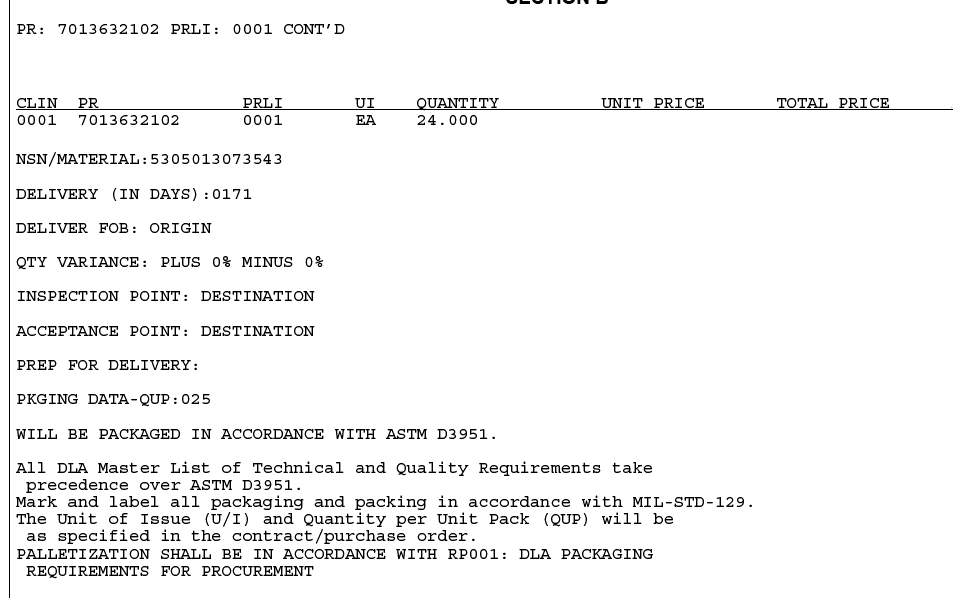
Before doing that, make sure you read the solicitation to do it, with key emphasis in 3 fundamental parts:
-
- FOB
-
- Packaging requirements
-
- Unit of Issue
In the case of this solicitation:
-
- Deliver FOB: Origin (this is the one we want because this means you just need to package the item based on their packaging specifications and let it in a FedEx or UPS facility depending on the shipper
-
- Inspection Point: Destination. Again this is the combination we want when we are starting. If this says, Inspection at ORIGIN, this means that the DCMA will visit your facility to inspect the product and packaging before shipping to the DLA. Passing a DCMA inspection is not something we want when we are starting, so avoid this in the beginning. Once you have more experience on this and your facility ready for it, then pursue contracts with inspection at ORIGIN
-
- Packaging requirements: ASTM D3951 This is the standard for commercial packaging.
-
- Unit of Issue: EA, which means Each
-
- QUP: 25, which means Quantity of Units per Package is 25. This means you will take a 4 mil poly bag and you will add 25 units of this product, seal it with heat, and then put a MIL-STD-129 label on it
After you get the quote from McMaster-Carr, you have to take the costs of the product plus shipping to your location plus the packaging costs.
For this particular product, let’s say that the product plus shipping costs $84 USD, so they are requesting 24 units, and for the packaging is commercial packaging (ASTM D3951), so you will need these packaging supplies:
-
- 1 4 mil poly bag for the 24 units (QUP is 025) ($0.10 per bag)
-
- 1 box of 4 x 4 x 4 for the intermediate container ($0.32 per box)
-
- 1 box of 6 x 6 x 6 for the exterior container ($0.45 per box)
-
- 2 4 x 6 shipping labels for the Military Shipping Label and one for the FedEx/UPS label (see the packaging supplies section)
-
- 2 3 x 2 labels for the MIL-STD-129 labels (one for the bag, and one for the intermediate container)
This means that the total costs are: $85 + $5 (for all packaging supplies) = $90. So, the true price per unit is $3.75 ($90 of costs / 24 units requested).
Now, you need to login to DIBBS, and send the quote for this solicitation:

Once you get there, you put your bid, and wait for the result. The most important thing to take into account is the price.
You have to be careful and you need to always apply the Warren Buffet two rules to do business:
-
- Rule # 1: Never lose money
-
- Rule # 2: Remember Rule 1
It’s very easy to lose money here, especially when you are working in a contract where the packaging requirements are based on the military standard (MIL-STD-2073-1E).
Take your time to analyze very closely your costs and give a fair price to the government.
THE TRACEABILITY REQUEST
Now after the bid, you get a weird email or call asking for something called “Traceability”.
That email looks like this:
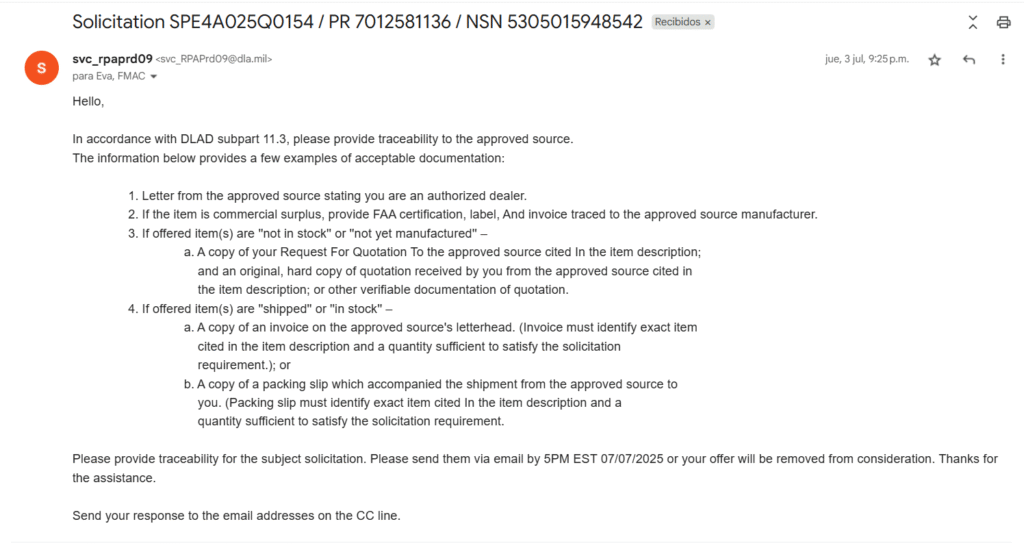
Don’t lose your hair on this: this is simply the way that the DLA has in order to check two main things:
-
- That you are getting this product from the actual manufacturer or an authorized distributor. Why is this important? Because there is a lot of counterfeit products out there, so making sure you are working with the actual OEM or an authorized distributor, is always important
-
- That you are eager to work with the federal government, so you take the call or answer that email in less than 24 hours. This is key, especially if you are starting in this journey
So, how can you answer this email? Basically you can send the quote you requested to your manufacturer before bidding. Following the same example with McMaster-Carr, when you request a “Request for Quote” to sales@mcmaster.com, they will send you a pdf with all the key information there.
That pdf is the document you need to send to the Contracting Officer (CO) that is requesting that information.
And please, for the love of God: send the pdf UNREDACTED. The DLA won’t fight with you for the price you put in your bid (unless you add 200% to the price that McMaster-Carr is giving you).
They know exactly how a McMaster-Carr quote looks like, so please don’t redact any part of the document, and send it without any modifications to the CO.
YOU WON THE AWARD. NOW WHAT
Now the actual fun part starts.
Many people only share the part when you bid, but we haven’t seen a lot of people sharing what happens after you win the contract.
Let’s change that with an actual example.
Before doing anything, you need to register in two additional portals:
-
- Vendor Shipping Module or VSM: this is the portal you will use to generate the shipping documents you will need in order to send the products to the DLA. Which are those documents? The shipping labels: the Military Shipping Label, the FedEx or UPS label, the Unit Container document, and the Packing Slip
-
- Procurement Integrated Enterprise Environment or PIEE: this is the portal you will use to send and monitor the invoices you will send to the DLA (or any federal agency)
These two portals will be your “bread and butter” after you win more and more awards.
Now, let’s focus on the actual execution of the contract.
The first thing you need to do is read the contract up and down at least 5 times, especially the key parts of it: FOB, Section B, Packaging Requirements, Due date, etc.
Then, go to VSM to generate the shipping docs. Before doing that, you need to have some packaging supplies in order to do it, and a digital scale to see exactly the weight of the parts you will send to the DLA.
There are some important rules you need to follow for the packaging part:
-
- Each intermediate container can weight 40 Lbs or less
-
- Each intermediate container can have 100 Unit Containers or less
Let’s use an example to illustrate this better. Let’s say you need to send 549 screws to the DLA, the Unit of Issue for this contract is EA which is each piece inside a bag, and the packaging standard for this one is ASTM D3951, which is commercial packaging.
The first thing you need to know is that you will need 6 Intermediate containers: 5 boxes will have 100 units each one, and the sixth box will have 49 units. The second thing is that you will need 549 bags (4 mil bags), and you will need 549 3 x 2 labels for each MIL-STD-129 label (see the packaging supplies section to know more about it).
Example of the MIL-STD-129 label
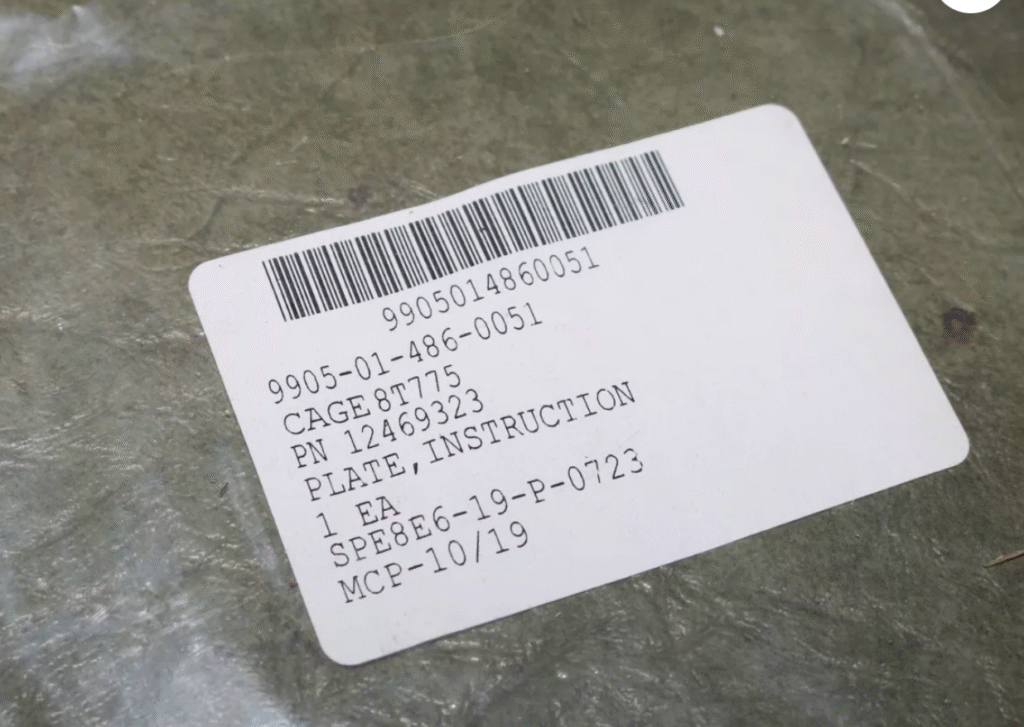
You need to put each of these labels outside of the 4 mil poly bag, heat seal it, and voila: you have prepared the Unit Container. Now, you will need to repeat that 549 times.
Now, after you prepare your Unit containers, now take 100 of those Unit Containers, and put them in an ASTM D5118 box (let’s say a 8 x 8 x 8 box), seal that box, and then outside of the box, you need to add another MIL-STD-129 label with the same information with just a small change: instead of 1 EA, you will add 100 EA, because that says that you have 100 items of the same screw inside that box.
You repeat that 5 times, and for the last box, you will place 49 Unit Containers, and the outside label of that box must reflect that as well.
Now, you have the Intermediate Containers ready, it’s time for the exterior container. We love to use the least amount of space for the exterior box, so in this case we could use a single box of 24 x 24 x 8.
Now, inside that box you need to add certain documents before closing it:
-
- The Unit Container printer in an A4 sheet
-
- The Packing Slip generated in VSM
-
- The Order confirmation or the Packing Slip sent by the manufacturer when you purchased the products (for traceability purposes)
Now, it’s time for closing that exterior box. Now, outside the box, you need to place the shipping labels:
-
- The FedEx or UPS label in the top right corner of the box
-
- The MLS label in the left of the FedEx label a little under
-
- and the RFID label in the bottom of the box
And on the side of the box, you need to place a sealed envelope with:
-
- The Packing Slip of the contract generated on VSM
-
- A copy of the invoice (not the one you will generate later in PIEE)
Here an example of the exterior box:
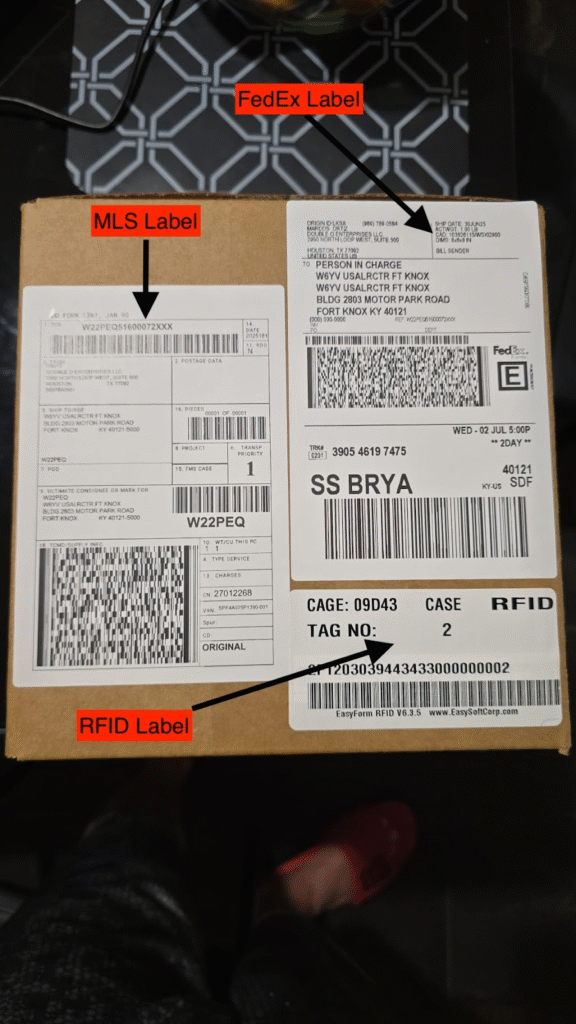
After that, the box is ready for FedEx.
If the box weighs less than 55 Kg, you can take the box and visit a FedEx office, and let it there.
If the box weighs more than 55 Kg the process is a little different: you need to request a pickup on VSM, and your facility must be ready for it.
After that, wait 24 hours, and you are ready to send your invoice in PIEE, and if you give a NET30 terms to the DLA, you will get paid in 30 days (is always less than that).
And voila: you executed your first contract with the DLA.
This is that we called the full cycle:
-
- Identify a contract you want to bid on DIBBS
-
- Request a quote to the manufacturer or distributor of the product
-
- Bid on that contract
-
- Ask for traceability
-
- Send the quote to the CO
-
- Win the award
-
- Package the goods based on the requirements
-
- Send the goods to the DLA
-
- Send the invoice in PIEE
-
- Get paid
-
- Repeat
THE SPRS SCORE AND NIST SP 800-171 AND CMMC COMPLIANCE
The Supplier Performance Risk System is a score given to any contract that works with the Department of Defense, and after 6 months you register with the DLA, they will start to ask about this score.
We did this right after we registered to work with the DLA, because now it’s a hard requirement to have it.
Our recommendation? Work with a company that is dedicated to this topic only. We recommend On Call Solutions
Note: this is not an easy task to do, and by definition is not cheap as well, but On Call Solution can give your company a good balance between costs and benefits.
Now, why do we recommend doing this?
Because:
-
- You need it on any route you pick (the distributor route or the manufacturer route)
-
- This will improve dramatically your company security posture
-
- You will need it for the JCP certification (more of this later in this post)
LET’S TALK ABOUT THE MANUFACTURER ROUTE
Now, let’s focus on the manufacturer route to work with the DLA. This particular route is a little more challenging, but not impossible to figure it out; and we strongly believe that this is the best route to be thinking long term.
Now, our recommendation is to start with the distributor route first.
Why? Because in that way, you can learn how to do the full cycle first (from bidding to get paid), you train your bidding muscle and you place the SOPs in your company to work with the DLA.
Execute at least 25 to 30 contracts with the DLA using the distributor route, and you will be ready for the next level.
Once you want to change your focus to the manufacturing side, the first thing you need to do is to self certify for your SPRS score.
THE DLA JOIN CERTIFICATION PROGRAM
After that, our recommendation is to get the Join Certification Program (JCP).
This certification will allow your company to have access to unclassified military technical data which is not available to the public.
Why will your company need this?
It’s simple: if you want to build a part for the federal government, you will need access to what they called “Technical Docs”, which are the technical drawings for that particular piece of equipment.
And of course, the US government wants to make sure that no enemies or adversaries could access that information.
How can you identify when a solicitation has Tech Docs?
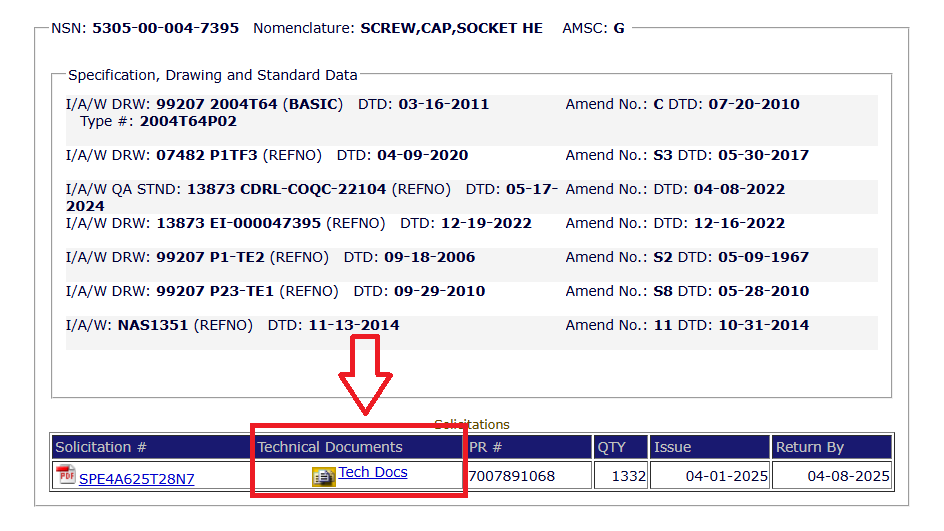
REQUIREMENTS FOR THE JCP CERTIFICATION
The requirements listed in the JCP portal are the following ones:
-
- Be registered and physically located in the U.S. or Canada
-
- Have an active SAM registration and CAGE / NCAGE code *
-
- Complete a cybersecurity assessment (NIST SP 800-171) / Upload results to the SPRS system
-
- Follow rules for protecting sensitive information (DFARS Clause 252.204-7012 )
After you have all this ready for your company, then, you need to visit the JCP portal and start the certification process.
The process is straightforward, you just need patience and all the company’s paperwork in front of you.
Some things you need to take into account:
-
- Your NAICS code matters more than you think for this step, so be very clear about it. If you have two or more NAICS codes, get all your paperwork ready as well
-
- The laptop or PC you will get access to the cFolders (Technical Docs) must use an IPv4 address, and must be located in the same physical address you share here. This is important because if your network is on IPv6-only network, your application can be rejected fo it
-
- The person (or people) to be in charge of accessing the Technical Docs must be an US citizen or an US permanent resident in the United States, and please don’t connect to the system from another laptop/PC in another physical location
After you complete the process, it takes two to three weeks for the response. If your company is approved, you will get a form called DD Form 2345.
Now, the next step is to get the DLA Enhanced Verification, and you can find the requirements here.
After this, your company will be ready to bid for manufacturing contracts with the DLA.
HOW TO FIND MANUFACTURING CONTRACTS WITH THE DLA
Now, it’s time to search for those manufacturing focused contracts with the DLA. There are several ways to do it, but our recommendation is to visit the Advanced Manufacturing section in the DLA website and read everything there.
After that, you can visit DIBBS, and search for contracts using this search term “potential additive”
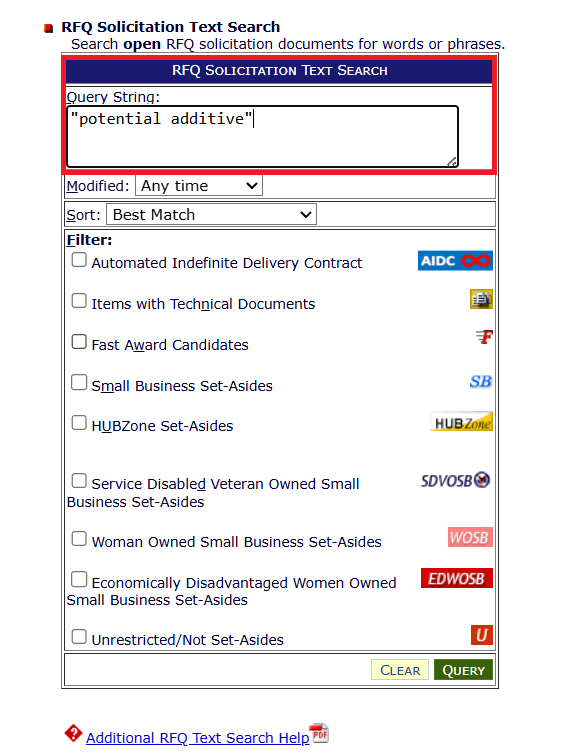
Right now, there are 5 records for it, and one of those solicitations is this one where the University of Dayton is the approved source for it:
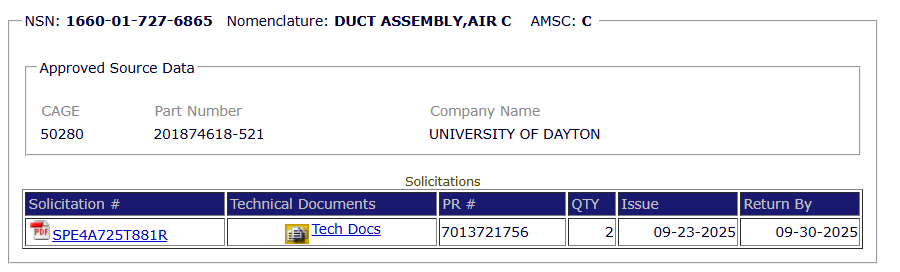
and if you read it more closely, you can see what needs to be built there.
Again: we are not an expert in this part of the DLA, for if you want to continue on that path, you need to figure it out on your own.
Another potential way to identify possible manufacturing contracts with the DLA could be the First Article Test type solicitations.
How can you see these solicitations? There are two ways to find those solicitations:
-
- Go to DIBBS-> Solicitations -> Recent RFQs
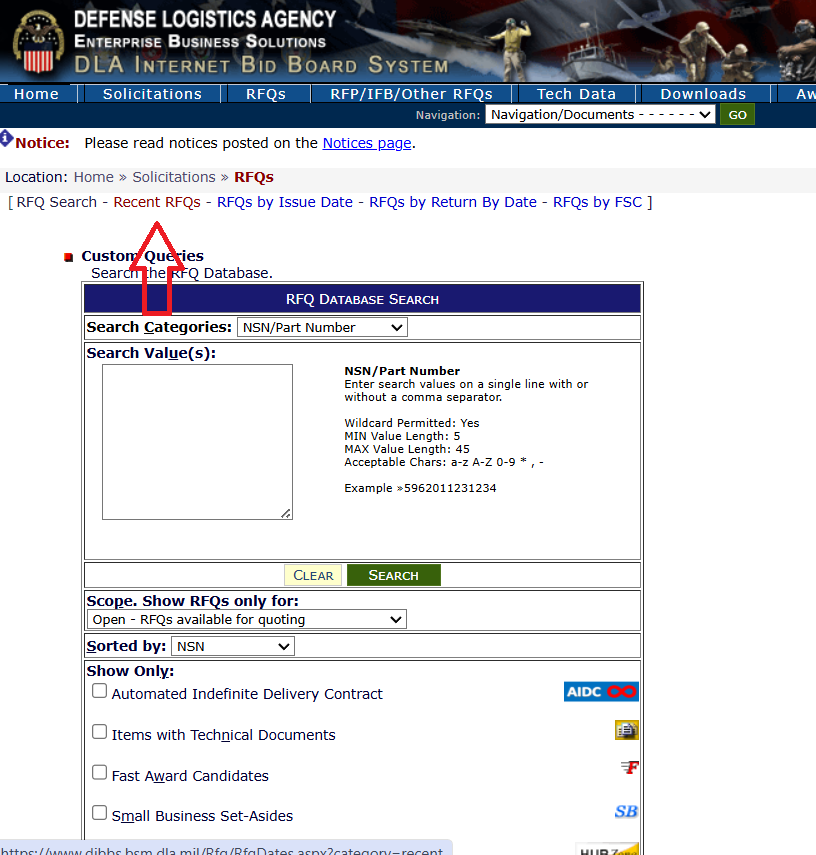
Then, select the current date for it (October 10, 2025), then sort the results based on the NSN
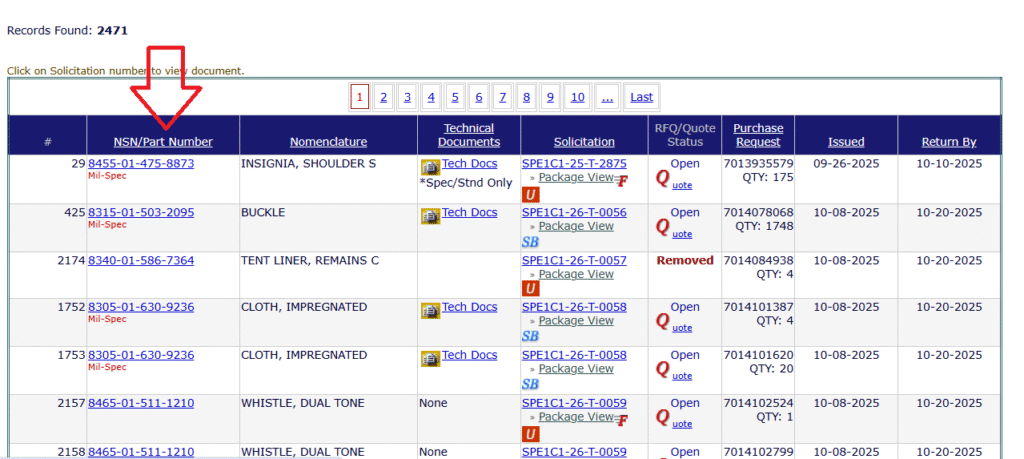
After that, you will see something like this:
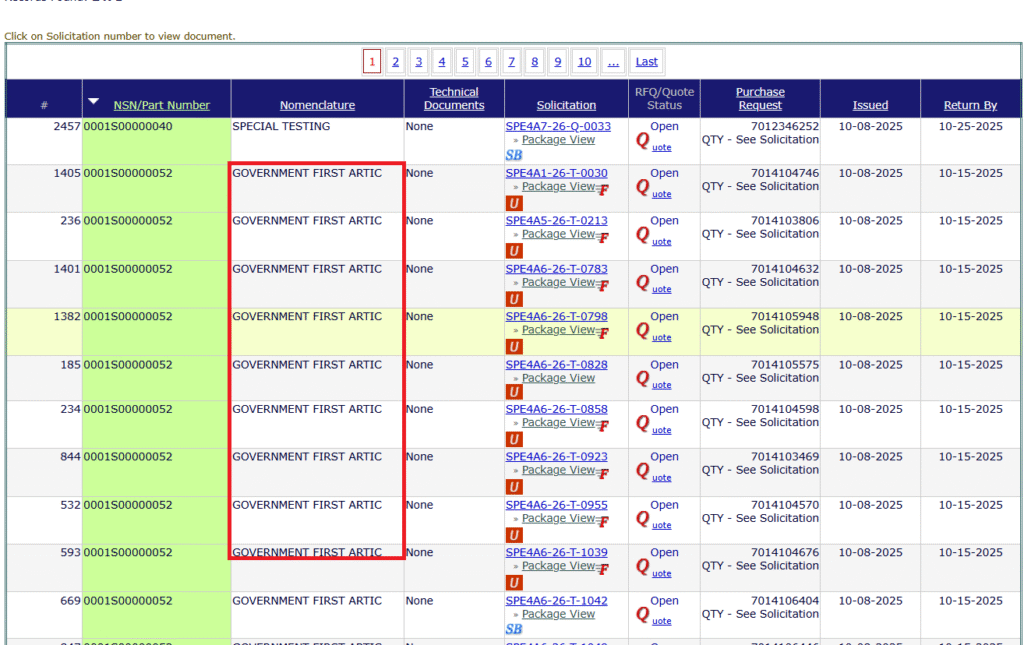
All those solicitations you see with the nomenclature “GOVERNMENT FIRST ARTICLE TEST”, all are manufacturing contracts.
The process to work with the solicitations is a little different, so I encourage you to watch this video about that topic from our good friends of Mend Sourcing Solutions
And the last method you could use to find manufacturing contracts with the DLA could be the one described on this demo from Loocey about how to find contracts with No Approved Source on DIBBS:
With Loocey, you could do more stuff, but this one is perfect for manufacturers.
There are other ways to work with the DLA from a manufacturer point of view, but we just wanted to share with you what we have found in the space.
Now, it’s bidding time.
Good luck
PACKAGING SUPPLIES
Boxes
-
- Weather Resistant boxes on ULINE https://www.uline.com/BL_420/Weather-Resistant-Boxes
IMPORTANT: The box must have one of these seals W5c or V3c
-
- For commercial packaging, you can use any ASTM D5118 box on ULINE
LABELS
-
- 3 x 2 labels for the Unit Containers labels (MIL-STD-129 standard)
Example:
-
- 4 x 6 labels for the shipping labels ( these are the labels that are put in the external containers)
Examples of a MLS label and a FedEx label
And see how they must be located in the exterior container:
Printers for the labels (Budget-Friendly)
We use the Rollo printer for both labels: 3 x 2 and the 4 x 6 labels
Yo uso la impresora Rollo tanto para las etiquetas 3 x 2 como para las etiquetas 4 x 6
Helpful accessories
-
- Label Holder: https://amzn.to/3IkmN8D
-
- Digital scale https://amzn.to/4eIVHUP
Professional printers for the labels
-
- Zebra ZD220: for the shipping labels (4 x 6 labels)
-
- Zebra zd421: for the Unit Container labels (3 x 2 labels)
RFID Labels
These are the labels you need for marking each exterior container you send to the federal government. It’s not a hard requirement, but it’s very helpful, especially when you are sending a big order with a lot of boxes.
We highly recommend using it in any shipment, even if the order is small.
We buy on this website
Bags for commercial packaging
For commercial packaging, we use the 4 Mil Poly Bags from ULINE perfect for it. https://www.uline.com/BL_109/Uline-4-Mil-Industrial-Poly-Bags
You just need to select the right size for the piece you will send to the government.
Impulse Sealer (Budget-Friendly)
This is the piece of equipment we use to heat-seal the bags for commercial packaging. This one is perfect for starting.
Once you want to do this part more professionally, you can move to a continuous band impulse sealer.
Bags for military packaging
Now, the MIL-STD-2073-1E is the standard for military packaging, which is a little more complicated but not impossible. You just need to follow the procedures for it, use the correct materials and you are good to go.
Let’s illustrate this with an actual example. In the Section B of each contract, you will find the packaging requirements. If you find something like this, this is the standard for military packaging:
So, what do you need to do in this case? You can use this tool from Leidos and “translate” the packaging codes to the corresponding materials, and follow the instructions for it.
Here’s the tool:
https://camphill.leidos.com/code_lookup.nsf
.
-
- QUP: Quantity per Unit Pack. In this case is 1, so on each bag, you need to place just one unit
-
- Method of Preservation: 33. In this case the part must be inserted in a bag that needs to compliant with the MIL-DTL-117 Type II, Class C, Style 1, 2, or 3
-
- Unit Container: BE. In this case the bag is actually a MIL-B-117, Type I, Class C, Style 1, heavy duty, waterproof, greaseproof, opaque bag.
-
- Intermediate Container: E5. This is a ASTM 5118 box, that can find on ULINE
So, where is this “bag”? We use this website to buy them in bulk
https://allmilspecpackaging.com/bags/mil-dtl-117-class-c-bags
-
- Unit Container: BL MIL-DTL-117, Type III, Class B, Style 2, heavy duty, waterproof, transparent Bag https://allmilspecpackaging.com/bags/mil-dtl-117-class-b-bags
-
- Unit Container: BS MIL-DTL-117, Type I, Class E, Style 1, heavy duty, watervaporproof, greaseproof, opaque bag. https://allmilspecpackaging.com/bags/mil-dtl-117-class-e-bags
Sealing Tape (Budget-Friendly)
We use this one from ULINE
O en Amazon también
Professional Sealing Tape
Cushioning
-
- Cush/Dunn Mat = “LC” and “NA” PPP-C-795 Class 1 cellular plastic film cushioning
-
- JA = ASTM-D4727, domestic fiberboard as a stiffener on one side of item
-
- JB = ASTM-D4727, domestic fiberboard as a stiffener on both sides of item
-
- JC = ASTM-D4727, domestic fiberboard used as pads, cells, die cuts or sleeves
Wrapping
-
- WRAP MAT = “CA” Mil Spec A-A-203, kraft wrapping paper, Style 1 https://www.tmtpackaging.com/product-page/a-a-203-kraft-wrapping-paper
OTHER RESOURCES
TOOLS
CONTACT US
If you still have any questions, please feel free to send us a DM on X at @marcosluis2186
That’s the fastest way to get a response. We make consulting calls as well, but many times the answer is simple, so we won’t charge a dime for it.
If the topic is a little more complex and we need to take some time to answer, we encourage you to schedule an 1 hour call with us.
Send us an email to marcos@doubleoenterprises.co and I will share the details with you there.